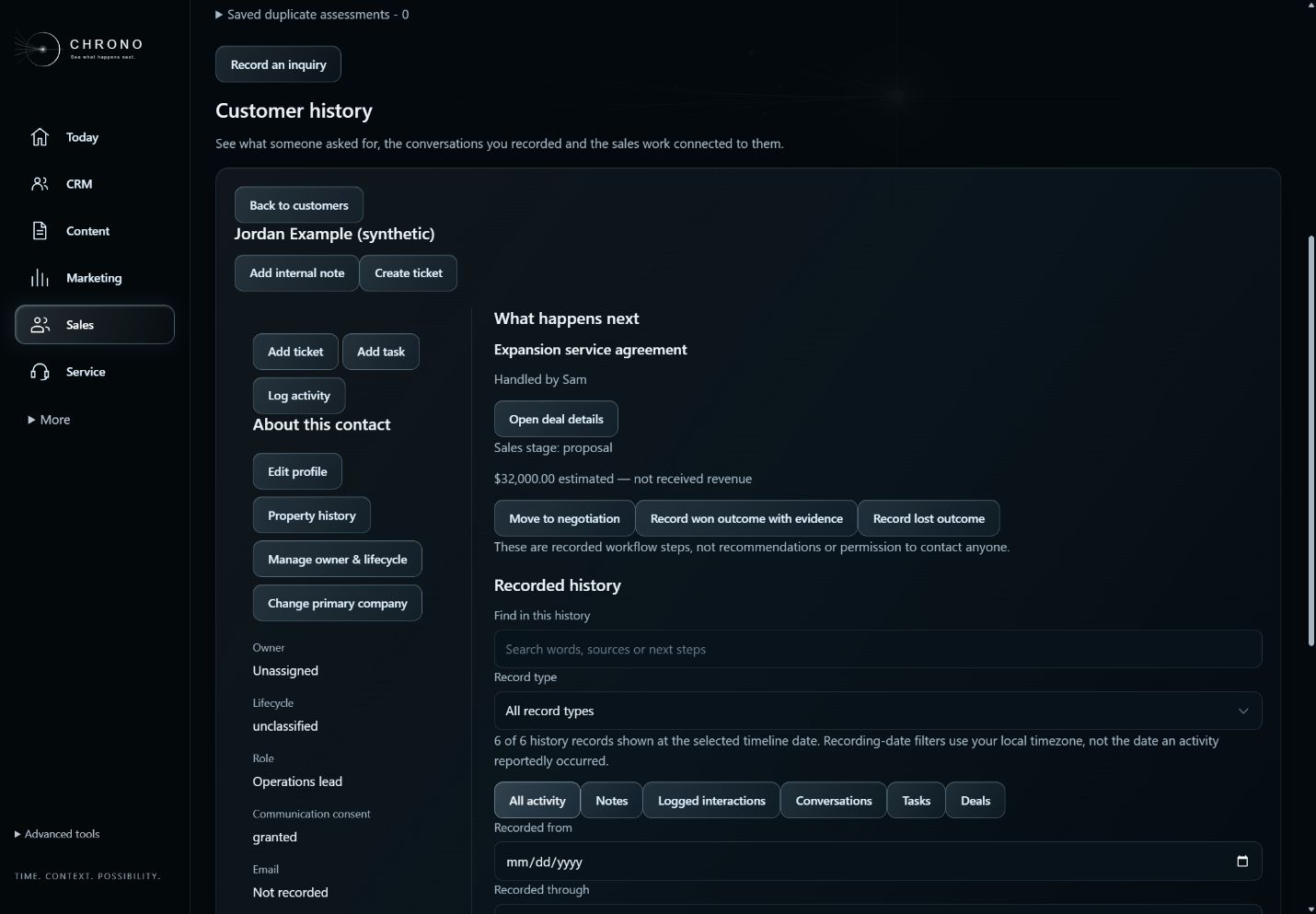

A customer record can be perfectly up to date and still leave you confused. The budget is different, the expected close date has moved, and someone has changed the next step. You can see the current position. You cannot easily explain how the business arrived there. Temporal CRM starts with that missing explanation: the relationship between events, the information available to your team, and the decisions that followed.
The latest value is only one view
Consider a small consultancy preparing a proposal. On Monday, its contact describes a $12,000 project starting next month. The team prepares a scope around that conversation. On Thursday, the contact explains that the budget was cut on Tuesday. A conventional current record might now show $8,000. That number is useful for the next conversation, but it cannot explain Monday’s proposal on its own.
The missing context matters during a handoff or review. Was the proposal careless? Did the customer change direction? Did the team receive important information late? Those are different situations with different lessons. Retaining the earlier picture helps a manager ask a fairer, more useful question than “Why did you use the wrong budget?”
Keep two clocks in the story
Event time describes when something happened. Knowledge time describes when it entered your working record. In the example, Tuesday is the reported budget-change date and Thursday is when the team learned about it. Keeping those ideas distinct makes it possible to discuss the relationship as it unfolded and the information behind a particular decision.
The distinction also helps when information arrives late or gets corrected. A later correction should improve the record while leaving enough context to explain earlier work. This is a discipline for recording evidence, rather than a reason to pretend that every date is certain. If the event date is unknown, mark it unknown instead of inventing precision.
Connect history to the work people do
A useful history reaches beyond a list of field changes. The proposal, campaign brief, customer conversation and follow-up task help explain one another. Link the source conversation to the changed assumption. Give the resulting task an owner. Make it possible for a colleague to follow the thread without reading every message in the company.
Start with one relationship that has changed recently. Record what changed, the source, the two dates where known, and the work affected. At the next review, ask a colleague to reconstruct the decision from those records. Any point where they have to guess is an opportunity to improve the handoff.
Use the past to frame a better next question
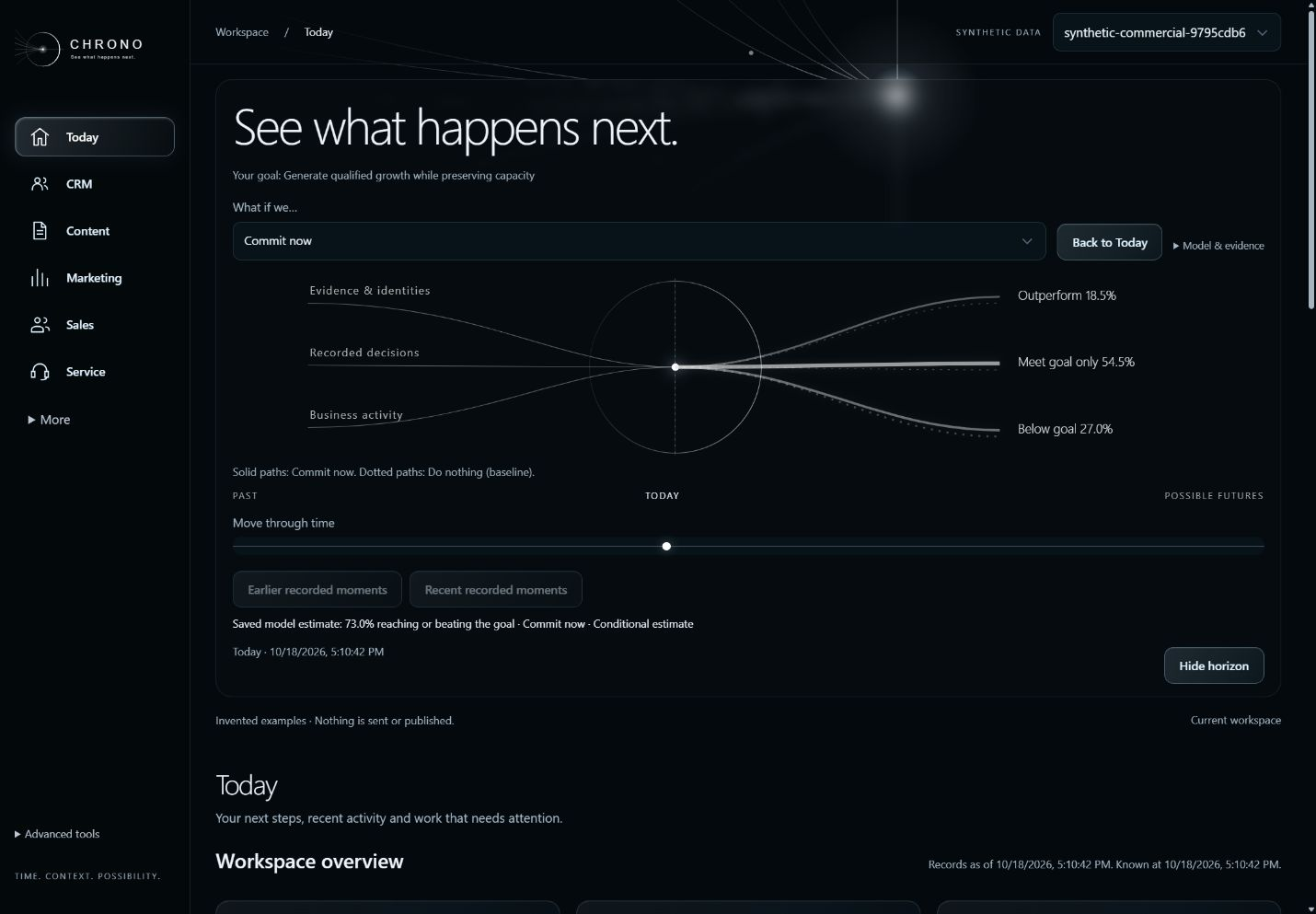
Historical understanding creates a foundation for exploring possible next steps. You might compare reducing scope, delaying the start, or keeping the original proposal open. Each option needs explicit assumptions. An exploration of what could happen belongs beside recorded evidence, with a clear distinction between the two.
Chrono brings this temporal perspective into a connected CRM and business workflow ecosystem. Historical context and model-conditioned scenario comparisons are part of the private beta; capabilities continue to be tested in supported workflows. Scenario planning belongs to the free CRM foundation. The goal is practical: understand an earlier choice, notice what changed, and make the next decision with more context.