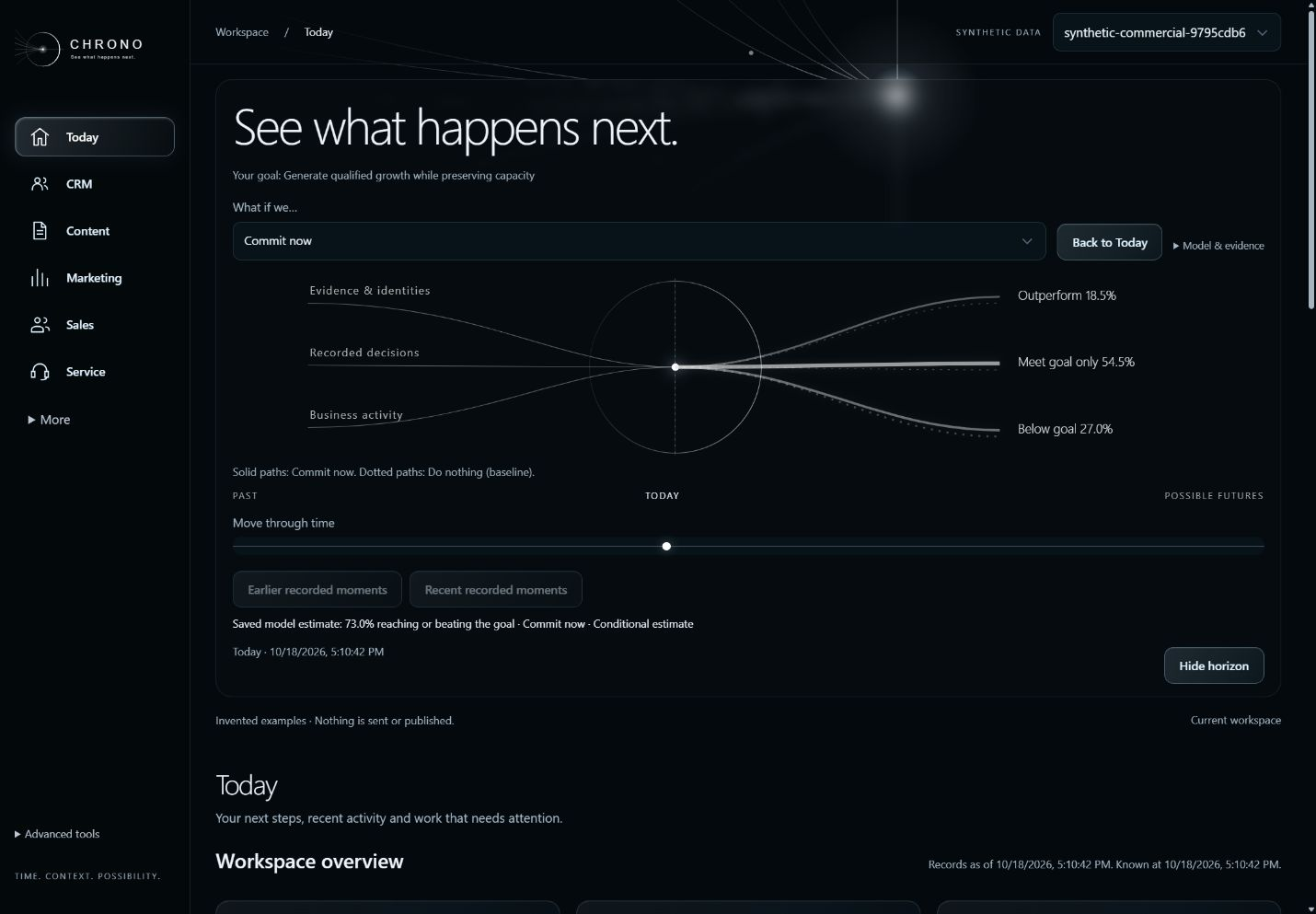

A chart of the future can look much more certain than the reasoning behind it. Smooth lines, precise numbers and a confident label can make an assumption feel like an outcome. Scenario planning is more useful when it invites a discussion: if these conditions held, how might our choices differ? That question gives a team something to examine without asking it to believe that the future has already been calculated.
Start with a decision you can make
Consider a team deciding whether to invite 200 customers to a pilot now or wait until next month. Useful options might be a full invitation, a smaller first group, and waiting. The decision has a time horizon, an owner and constraints on staff capacity. A scenario should help compare those choices, rather than produce an impressive number detached from an actual action.
Include the baseline. Doing nothing can have consequences too: the team may preserve capacity, delay learning, or miss a useful window. State what “do nothing” means over the chosen period. Otherwise, one option may include ongoing work while another quietly assumes that the business stops moving.
Put assumptions where people can challenge them
For a simple planning exercise, a 5% response assumption applied to 200 invitations gives ten replies. At 2%, it gives four. This arithmetic says nothing about which response rate will occur. It does show how strongly the staffing conversation depends on the assumption. If four replies and ten replies require different follow-up plans, the assumption deserves attention.
A more complex model still depends on inputs, structure and a horizon. Ask where those inputs came from, which important factors are missing, and what the result actually measures. Use enough detail to support the decision. Adding more decimal places does not resolve a weak assumption.
Keep three kinds of statements separate
“Six customers replied last week” is an observation when backed by records. “The offer seems more relevant to this group” is an interpretation. “A similar invitation might generate ten replies” is a modeled or assumed outcome. All three can contribute to a discussion, but they should carry different labels and sources.
This distinction helps when an optimistic scenario is repeated in a meeting. A possible result can quietly become a target, then a commitment, and finally a supposed fact. Preserve the original assumptions and context so that the team can return to the actual question instead of relying on a remembered headline.
Decide what you will learn next
A good scenario discussion often ends with a smaller information-gathering step. The team might test a draft with a few customers, confirm staff availability, or check a constraint before choosing the full campaign. Record the decision, the reason and the evidence that would cause you to reconsider it.
After the work, compare the recorded outcome with the assumptions. The aim is to improve the next decision, not to rewrite the earlier scenario until it appears correct. Chrono includes scenario planning in its free CRM foundation and is developing model-conditioned comparisons in private beta. Treat those comparisons as tools for exploring choices, with people responsible for deciding what to do.